




25.11.07 - computing language is evolving
Why 'Vibe Coding' and 'AI Hallucinations' Are Now in the Dictionary - and What It Means for Your Computing Lessons
Your Dictionary Just Got an AI-Powered Update
Have you noticed a bunch of new technology words appearing everywhere? You're not wrong. In 2025, the Collins Dictionary officially named "vibe coding" as its Word of the Year. This term, which describes using plain English to tell an AI to write code for you, barely existed before February 2025. This comes just two years after its direct ancestor, "AI" (artificial intelligence), was Collins's Word of the Year for 2023.
This flood of new terms is happening because the "AI Boom" is forcing our language to evolve just to keep up. Dictionaries add words only when they see widespread, sustained use, and AI-related terms are now dominating the lists, providing hard evidence that this is one of the biggest tech shifts in history.
For you, as a computing student, these "buzzwords" are a direct preview of your future. The "Word of the Year" data tells a clear story of this progression. First, in 2023, dictionaries had to define the main concept for the public, choosing "AI". Immediately after, they had to name the problem this new concept created. Cambridge chose "hallucinate", while Merriam-Webster chose "authentic" , precisely because AI and deepfakes were forcing everyone to question what is real. Now, in a very short span, the public conversation has matured to high-level application, which is perfectly captured by 2025's winner, "vibe coding".
This article will decode these terms and show you why they are directly related to your computing lessons.
1
The New AI Lexicon — Your Essential Decoder Ring
First, Generative AII have no idea what this means (GenAI) is a type of AI that creates new content (text, images, code) instead of just analyzing data. The engine inside many of these tools is a Large Language ModelI have no idea what this means (LLM), which is like a super-powered predictive text system. It's a neural networkI have no idea what this means that has been trained on a massive chunk of the internet to, word-by-word, calculate the most statistically likely next word in a sentence.
The skill of getting good answers from an LLM is called Prompt EngineeringI have no idea what this means. This is the technical craft of designing, refining, and evaluating the plain-English instructions (prompts) you give to an AI to guide it toward an accurate and relevant output.
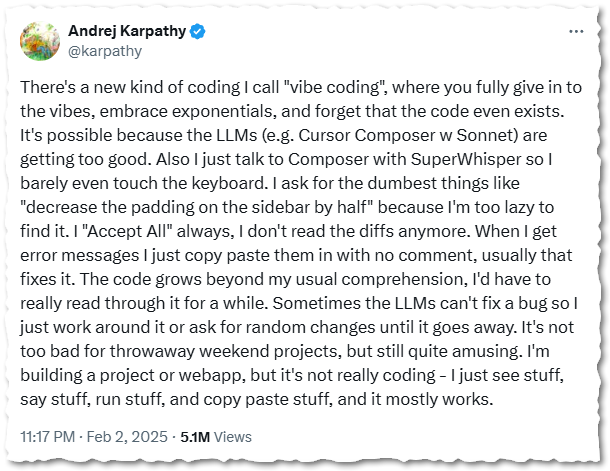
When you use prompt engineering to write code, you're doing Vibe CodingI have no idea what this means. Coined by AI pioneer Andrej Karpathy, it means telling the AI what you want ("make me a website for my meal-planning app") and letting it generate the code. It’s programming by "vibes", not by precise variables.
Of course, these tools have serious problems. The most famous is the AI HallucinationI have no idea what this means. This is when an AI confidently "makes up" a "fact" that sounds plausible but is completely wrong - it's not lying, it's just fabricating. This has real-world consequences, such as when a law firm was fined for citing six non-existent court cases that ChatGPT had invented.
A more malicious tool is the DeepfakeI have no idea what this means. The term is a mix of "deep learning" and "fake" and refers to a "digital imposter" - an AI-generated video or audio file of a person saying or doing something they never did. This has created a new, powerful tool for misinformation and fraud.
This tension is captured by another word on the 2025 shortlist: Clanker. It's a derogatory slang term, popularised by Star Wars, used to express frustration with, and distrust of, AI chatbots. The fact that both "vibe coding" (optimism) and "clanker" (frustration) are on the same list perfectly captures our society's love/hate relationship with this new technology.
Two other big concepts you'll hear about are the Digital TwinI have no idea what this means and the MetaverseI have no idea what this means. A Digital Twin is a living, real-time virtual model of a real-world object, like a jet engine or a wind turbine. It’s connected to its physical counterpart by IoT sensorsI have no idea what this means, allowing engineers to run simulations and predict failures before they happen. The Metaverse, a term from the 1992 sci-fi novel Snow Crash, is the idea of a single, persistent, 3D internet that you "walk around in" using an avatar.
2
Connecting the Dots — Why Your Computing Lessons Are More Important Than Ever
All these "new" technologies are just the practical, real-world application of the exact things you're learning in class.
At Key Stage 3, your lessons on logic and algorithms - specifically the need for "precise and unambiguous instructions" - are the foundation of prompt engineering. A good prompt is an algorithm. Your data representation lessons are the first step to understanding how LLMs work, by turning all language into numbers (vectors) that can be manipulated.
At Key Stage 4 (GCSE), the skills of testing and refining programs are becoming more valuable, not less. Vibe coding automates the "writing" part, but it often creates buggy code, shifting your job to testing, validating, and debugging what the AI produces. If you study a unit on "ethical, legal and cultural impacts", it is no longer theory; it’s the real-world study of deepfake fraud, the societal harm of AI bias from bad data, and the misinformation spread by AI hallucinations.
By the time you reach Key Stage 5 (A-Level), you should be confident using these agents and models. Even if there is no curriculum coverage of "Artificial Intelligence" you should still skill yourselves up, particularly in the study of the neural networks and machine learning models that power Generative AI. Any "Ethics and Ownership" component is now a direct job description for entirely new careers.
3
The New Job Market — What You Can Get Paid For
This new language is appearing on job descriptions for high-paying roles that didn't exist a few years ago.
The Prompt Engineer acts as an "AI Translator". This role blends programming logic with linguistics to design, test, and refine the instructions that guide AI models. A critical part of the job is actively testing for and mitigating AI bias. It's a real and lucrative career, with an average UK salary between £65,000 and £100,000.
The AI Ethicist acts as the "AI Conscience" inside a tech company. Your job would be to analyze new AI systems to ensure they are fair, transparent, and don't cause societal harm , such as perpetuating discrimination or enabling privacy violations. This is an increasingly critical role, with an average UK salary between £50,000 and £90,000.
Conclusion
The flood of new words in the dictionary is hard proof that the world is changing at high speed. As a computing student, you are not just an observer of this change; you are its designated architect. You are in the unique position of learning the "source code" of this revolution.
When you're in your computing lessons, remember these connections. Your KS3 lesson on logic is the fundamental antidote to AI hallucinations. Your KS4 ethics unit is the job description for an AI Ethicist. And your A-Level study of neural networks is the blueprint for building the technology that will become the next "Word of the Year".
Last modified: November 7th, 2025