




lesson 3.3.1 the project brief
Kick off your digital media project by learning how to decode a client brief and set watertight success criteria. Don't build a video nobody wants to watch!

Welcome to the director's chair! Today, we are acting as Digital Project Managers. Before we even touch a camera or open our editing software, we need a plan. We are going to crack the code of a project brief to figure out exactly what our client wants and who will be watching our video. It is time to set our goals so our final movie is a box office smash!
Learning Outcomes
The Building Blocks (Factual Knowledge)
The Connections and Theories (Conceptual Knowledge)
The Skills and Methods (Procedural Outcomes)
Recall the key stages of a simple project lifecycle including analysis, design, implementation, testing, and evaluation.
Describe the purpose of setting clear success criteria for a project to judge if it has been successful.
Describe how fitness for purpose is judged against a set of agreed success criteria.
The Connections and Theories (Conceptual Knowledge)
Analyse a project brief to determine the core requirements and constraints.
Evaluate the needs of a specific target audience to understand how this influences the final product.
The Skills and Methods (Procedural Outcomes)
Apply analytical techniques to deconstruct a written project brief.
Create a robust set of measurable success criteria based on client requirements.
Digital Skill Focus: You will manage the early stages of a digital project by understanding the brief and defining clear success criteria before beginning your creation.
Decoding a Project Brief
Every great digital product, whether it is a blockbuster video game, a helpful mobile app, or an engaging website, starts with a Project Brief.

A project brief is a formal document provided by a Client (the person or company who wants the product made). It acts as the ultimate set of instructions for the project. If you do not read the brief carefully, you might build a fantastic product that the client simply does not want!
A good project brief will always contain:
The overall goal or purpose of the project.
The specific requirements (what the product absolutely MUST do).
The constraints (the limits on the project, such as time, budget, or specific software to be used).
A bad project brief? Well - let's have a look at some...
The "Next Big Game" Brief

"I want you to make me a cool video game about a hero. It needs to be really fun, have great graphics, and I need it finished soon."
"I want you to make me a cool video game about a hero. It needs to be really fun, have great graphics, and I need it finished soon."
The "School App" Brief

"We need an app for the school. It should do everything the students need during the day. Oh, and the background must be blue."
"We need an app for the school. It should do everything the students need during the day. Oh, and the background must be blue."
The "Party DJ" Brief

"I am having a party and I need a computer program to play the music. Make sure the music is good and the program doesn't break in the middle of the night."
"I am having a party and I need a computer program to play the music. Make sure the music is good and the program doesn't break in the middle of the night."
Knowing Your Target Audience
Once you understand the rules of the project, you need to figure out who is actually going to use it. This group of people is called the Target Audience.
If you are designing an educational game for five-year-olds, your design choices (bright colours, large text, simple controls, audio instructions) will be completely different from an app designed for professional accountants (clean interface, complex data tables, advanced search features). Understanding the target audience ensures the final product is Fit for Purpose. Often designers don't design for a broad audience, they design for a made up person in that audience called a persona.
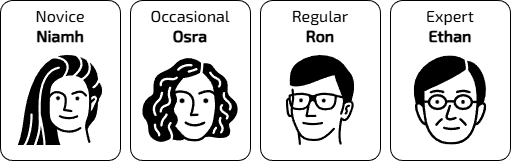
Audience personas
Setting Success Criteria
How do you know when your project is finished and ready to hand over to the client? You check it against your success criteria - a specific, measurable list of goals that the final product must achieve. They are created during the planning phase by looking closely at the client requirements and the needs of the target audience. Good success criteria are easy to test.
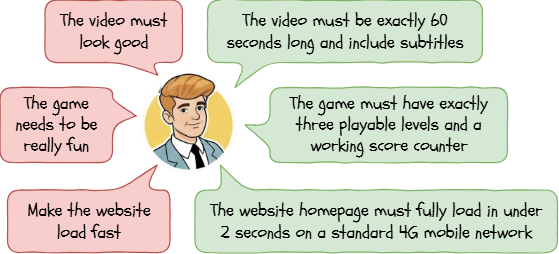
Turning bad into good

Task Crack the Client Code
It is time to step into the shoes of a Digital Project Manager! The client has just emailed over a 'brief' (if you can call it that) for your new digital media project. If you mess this up, the client will not pay!
1
Get Organised!
Either...
Grab a copy of the client email from your teacher.
Get three different coloured highlighters.
Or alternatively...
Download a copy of the email as a Word document.
Open it up in Word (other Word Processors are available.)
Remember to click the Enable Editing button if it appears on the yellow bar.
You don't need highlighters for this - Word already has a highlighter tool built in!
2
Deconstruct the Brief
Read through the email carefully.
Use YELLOW to highlight Requirements (things the product MUST do or include).
Use GREEN to highlight Constraints (limits, like time, budget, or file type).
Use PINK to highlight Target Audience and Tone.
3
Define Your Success Criteria
Open a blank word processing document.
Translate your highlighted notes into a numbered list of strict, measurable Success Criteria.
Remember, every criterion must be testable!
Need inspiration? Check out this search: Examples of Success Criteria
4
Consult the AI Project Manager
Struggling to understand why this matters? Ask our AI expert for a quick pep talk.

Act as an expert digital project manager. Explain what fitness for purpose means in software design. Keep the explanation under 50 words. The audience is 12-year-old Key Stage 3 students. Use a fun and highly encouraging tone. You must use exactly three bullet points. NO intro, NO outro, NO deviation from the topic, NO follow-up questions.
Outcome: A digital document containing at least 5 clear, testable success criteria based on the client brief.




Last modified: May 7th, 2026