




generative ai and prompting
Generative AI and prompt engineering. Learn structured inputs for controlling AI model output quality.

Welcome to Generative AI - technology that creates rather than just recognises. Like a master chef whose recipe determines the meal, the secret to unlocking its creative power lies in the precision of your instructions. Today, you will master the eight essential ingredients of top quality prompt writing to transform from a passive user into a true "Prompt Master Chef" who commands AI.
Learning Outcomes
Declarative (Knowing That)
I can explain the difference between Analytical AI (which classifies) and Generative AI (which creates).
I can define 'prompt engineering' as a crucial technical skill for controlling AI output.
I can list the key components of a structured prompt, such as role, task, audience, and constraints.
Conceptual (Knowing Why)
I can explain why providing specific instructions to an AI results in a more useful and accurate output.
I can describe how different components of a prompt (like role and audience) work together to shape the AI's response.
I can reason that prompt engineering is necessary because AI models predict responses based on instructions, rather than truly 'understanding' a request like a human.
Procedural (Knowing How)
I can formulate a highly structured prompt for a Generative AI tool.
I can explicitly define a persona, context, and format to achieve a precise result from an AI.
The Master Chef's Guide to AI: Cooking Up the Perfect Prompt
You've already seen how AI can analyse and classify things - like in Google's Quick, Draw! or when you trained your own Teachable Machine. That's Analytical AI. Now, we're moving on to Generative AI - a powerful type of AI that can create brand new text, images, and ideas from scratch.
But there's a trick to it. An AI is not a mind reader; it's more like a highly capable master chef. If you just ask for "food," you might get a bowl of plain porridge. If you ask for "a spicy pepperoni pizza with a stuffed crust," you know exactly what’s coming out of the oven.
To get the best results, you need a solid recipe. This skill is called prompt engineering, and it's a vital skill for anyone working as a modern Communicator. Your job is to give instructions that are so clear, even a machine can't get them wrong.
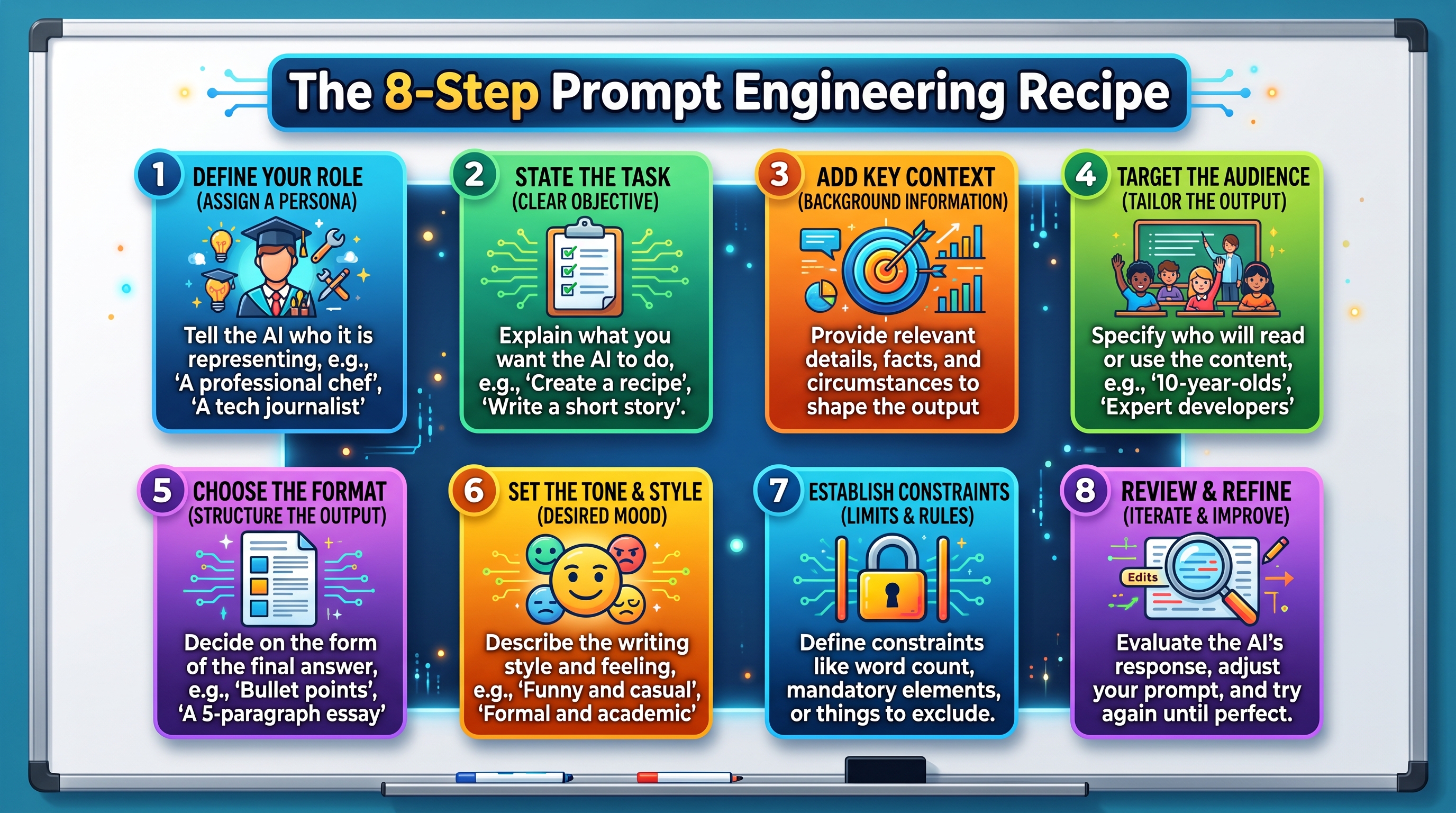
The 7 Essential Ingredients of a Perfect Prompt
1
The Role: Who is cooking?
Telling the AI who it should pretend to be completely changes the depth of its knowledge and how it approaches your question.
"Act as a GCSE History examiner..."
"Take on the role of an expert Python programmer..."
"Act as a supportive debate coach..."
2
The Task: What is the main dish?
This is the core of your prompt. You need to be incredibly clear about the exact action you want the AI to take. Use strong action verbs.
"...explain the causes of World War I..."
"...find the bug in this block of code..."
"...proofread my geography essay for spelling mistakes..."
3
The Audience: Who is eating the meal?
Telling the AI who will be reading the output completely changes the vocabulary and complexity it uses. A Year 7 student needs a very different explanation to an A-Level examiner.
"...explain this so a 10-year-old can understand it..."
"...write this as a study guide for my Year 11 classmates..."
"...structure this draft to impress a strict university admissions tutor..."
4
The Tone: What is the flavour profile?
Tone dictates the mood and personality of the writing. An AI defaults to a slightly bland, overly helpful voice. You have to explicitly tell it to be funny, serious, or academic.
"...write this in an enthusiastic and encouraging tone..."
"...make the tone academic, objective, and formal..."
"...use a witty and sarcastic tone..."
5
The Context: What's the background?
The AI doesn't know what you've been learning in class. Giving it the "why" behind your request helps it tailor the answer to your exact situation.
"...I am studying for my mocks and keep forgetting the timeline..."
"...this is for a beginner's science project..."
"...I understand the basic maths, but I am stuck on this specific formula..."
6
The Format: How should it be plated up?
If you don't specify a format, the AI will usually write paragraphs of text. You can tell it exactly how the final output should look to save yourself time.
"...give me the answer in three short bullet points..."
"...create a comparison table with two columns..."
"...write this as a rap song..."
7
The Constraints: What are the strict rules?
These are the hard limits the AI must follow. This stops the AI from waffling on for pages or using words you don't understand.
"...keep it under 200 words..."
"...do not use complicated jargon..."
"...only use historical sources from the 19th century..."
I would generally also include "Do not hallucinate to please me. NO intro, NO outro, No deviation from the topic, NO follow-up questions".
Putting It All Together: From Porridge to Perfection
You don't need all 7 ingredients every time, but combining them is how you get magic.
The "Plain Porridge" Prompt
Tell me about photosynthesis
This is too vague. The AI has to guess the audience, tone, format and everything else.
The "Master Chef" Prompt
Act as a grumpy science tutor. Explain how photosynthesis works. Explain it for a Year 9 student. Use a funny and slightly sarcastic tone. I am revising for my biology test tomorrow and I keep getting confused by the chemical equations. Give the answer in three short bullet points. Keep the whole thing under 150 words. Do not hallucinate to please me. NO intro, NO outro, NO deviation from the topic, NO follow-up questions.
This is much better. It's specific, clear, and tells the AI exactly what you need.
Think like an examiner! Look at the 7 ingredients for a good prompt and write down two common mistakes or 'traps' you think students might fall into when writing their own prompts. How will you make sure you avoid them?

Task Become a Prompt Master Chef
🌶️ Mild
Your task is to take the "Master Chef" prompt from the lesson notes and break it down to prove you understand its structure.
1
Get Organised!
Grab your whiteboard. Create a table with two columns: 'Ingredient' and 'Example'.
List the 7 ingredients (Role, Task, Audience, Tone, Context, Format, Constraints) in the first column.
2
Deconstruct the Prompt
Look carefully at the "Master Chef" prompt about photosynthesis from the lesson notes.
Carefully read the prompt and identify which part corresponds to each of the 7 ingredients.
Fill in your table by copying the exact text from the prompt into the correct row. For example, for 'Role', you would write "Act as a grumpy science tutor".
3
Show the Teacher
Once your table is complete, show your teacher your whiteboard so they can check your understanding.
🌶️🌶️ Hot
Your task is to take a weak, "Plain Porridge" prompt and transform it into a much stronger "Master Chef" prompt for a specific audience.
1
Get Organised!
Here is your "Plain Porridge" prompt
Tell me about the water cycle
Your goal is to rewrite this prompt to be suitable for a Year 5 student who is creating a poster for a school science fair.
2
Add the Ingredients
Open up a text editor like Notepad. Write a new, improved prompt that includes at least five of the seven ingredients.
Think carefully: What Role should the AI take? What is the specific Task? Who is the Audience? What Tone would be best? What Format would be useful for a poster?
3
Test and Refine
Once you have written your prompt, open a blank Gemini AI mode prompt.
Copy and paste your prompt into the AI and see what it produces.
Does it need any refinement?
Show your teacher both your prompt and the AI's output. Be ready to explain which ingredients you used.
🌶️🌶️🌶️ Spicy
Your task is to create a completely original "Master Chef" prompt from scratch to help you with revision for another school subject.
1
Get Organised!
Choose a topic from a different subject you are currently studying (e.g., History, Geography, Science, English).
Think about something you find tricky or need to revise for that topic.
2
Engineer Your Prompt
Open a text editor like notepad. Write a brand new prompt from scratch that uses all seven of the ingredients from the lesson notes.
Your prompt must be designed to generate a useful revision resource for you. Clearly label each of the 7 ingredients in your document. For example:
Role: Act as...
Task: Create a...
Audience: Explain this for...
...and so on.
3
Test, Evaluate, and Refine
Open up a blank Google Gemini AI Mode search. Copy and paste your finished prompt into it.
Run the prompt. What do you see?
Critically evaluate the AI's output. Did it follow all of your instructions? Was the output useful?
If needed, refine your prompt to improve the result.
Show your teacher your final, annotated prompt and the AI's response.
Outcome: A portfolio of three engineered prompts demonstrating a clear understanding of how to structure inputs to control AI output.


Post-It Note Homework
On a post-it note, answer this question and bring it to our next lesson: "What is the biggest mistake you think people make when talking to an AI, and how will you make sure you avoid it in the future?"
Last modified: September 20th, 2026