




003. the digital divide: why doesn't everyone have internet (ks3)
Explore the digital divide to understand why unequal access to the internet and technology affects education and opportunities worldwide.
It is easy to take smartphones and fast internet for granted, but what if you could not get online at all? The "digital divide" is the gap between people who have access to modern technology and those who do not. In this lesson, we will investigate why this gap exists and how missing out on the internet can change a person's life and opportunities.
The Great Disconnect: Navigating the Digital Divide
Imagine a World Offline
Imagine waking up to find your smartphone has no signal, your home Wi-Fi is completely dead, and you cannot message your friends or stream any music. For a few hours, it might just be annoying. But what if it was like that forever? For billions of people around the world, and even thousands of families right here in the UK, this is their daily reality. This gap between those who have easy access to digital technology and those who do not is known as the digital divide.
Why Does the Divide Exist?
The digital divide is not just about whether you own a computer; it is much more complicated. Firstly, there is the issue of cost. High-speed internet contracts and modern laptops are expensive, meaning people with lower incomes often miss out. Secondly, there is infrastructure. If you live in a remote, rural village, the physical cables required for superfast broadband might simply not exist yet, whereas cities are fully connected. Finally, there is the skills gap. Even if someone has a laptop and Wi-Fi, they might not have the education or confidence to use them safely and effectively.
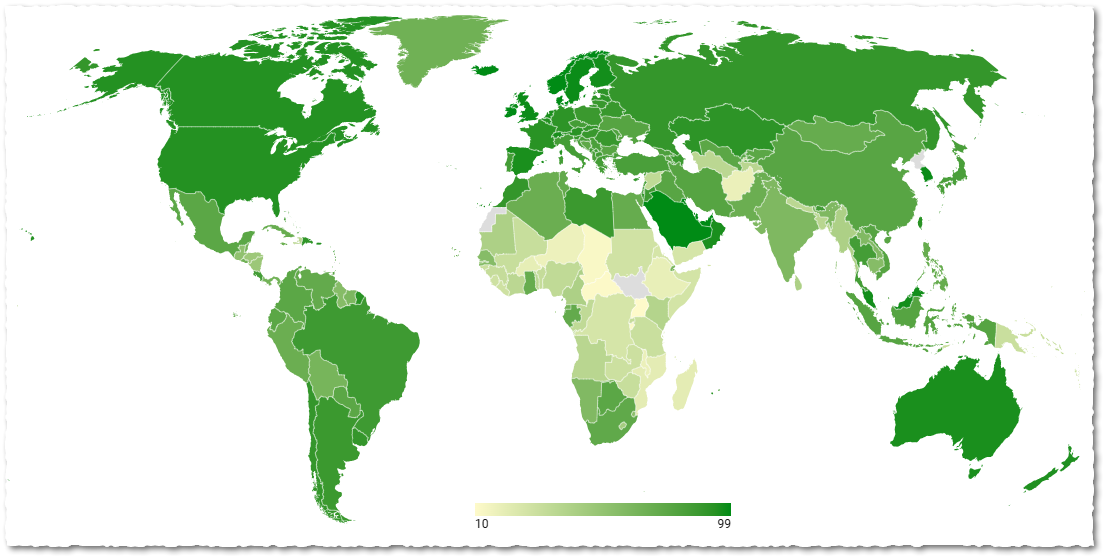
Percentage of population with access to the Internet
The Real-World Impact
Why does this matter? Because the internet is no longer just for entertainment; it is essential for modern life. Without it, students struggle to research their homework, adults find it incredibly difficult to apply for jobs, and elderly people can become socially isolated. As a Responsible Innovator, it is vital to remember that computing is not just about writing clever code. It is about fairness and equality. We must always ask ourselves: when we build new technologies, are we making the world better for everyone, or just leaving more people behind?
Comprehension Questions
Make sure you have read the passage carefully. Grab yourself a piece of lined paper and put your name, class and date at the top. Attempt the questions following questions making sure to answer in full sentences.
Knowledge, recall, identification
1
What is the definition of the digital divide?
2
Name two reasons mentioned in the text why someone might not have access to the internet.
3
State one way a lack of internet access can affect a student's schoolwork.
Analysis & Interpretation
4
Explain why living in a remote rural area might make it harder to get a fast internet connection compared to living in a big city.
5
Compare the impact of the digital divide on an elderly person living alone versus an adult looking for work.
6
Analyze how a lack of digital skills could prevent someone from successfully using a brand new laptop, even if it was given to them for free.
Synthesis & Creation
7
Imagine you are a local council leader. Propose a new community project that could help reduce the digital divide in your town.
8
Describe a concept for a poster that encourages people to donate their old, working laptops to families in need.
9
If high-speed internet suddenly became free for everyone on Earth tomorrow, predict two major changes we would see in society over the next five years.
Evaluation & Justification
10
To what extent is access to the internet a basic human right? Justify your answer using evidence from the text and your own knowledge.
11
"Providing free laptops to everyone is the only way to solve the digital divide." Evaluate this statement, considering both the benefits and the limitations of this idea.
12
Assess the degree to which massive technology companies should be held responsible for providing affordable internet to poorer communities.
Plugged Task: The Connectivity Campaign

Your local council has just received funding to improve technology in the area, but they do not understand why the digital divide is such a big problem. Create a one-page digital campaign poster using a word processor or presentation software to explain the issue and convince them to spend the money helping those without internet access.
The Persona
You are acting as The Responsible Innovator. Your job is not just to talk about cables and Wi-Fi speeds, but to focus on fairness. You care about how technology affects real people and want to make sure nobody gets left behind.
1
Get Organised
Open your chosen software and set up your document.
Open a blank document in a word processor or presentation tool.
Add a bold, clear title at the top of your page.
Save your file immediately using the filename Digital_Divide_Campaign.
2
Gather Your Evidence
You need facts to make your campaign convincing.
Use a search engine to find out how many people in the world still do not use the internet.
Click the link below to search for some up-to-date facts using a Google image search: Global Internet usage statistics by country
3
Understand the Infrastructure
You need to explain to the council why rural areas struggle to get fast internet.
If you are finding it hard to understand why laying cables in the countryside is difficult, use this Google AI prompt to generate a simple explanation:
You are an expert telecommunications engineer. Explain why it is physically difficult and expensive to build fast internet networks in rural countryside areas compared to big cities. Keep your response under 100 words. Write for a 12-year-old student. Use an encouraging and educational tone, avoiding overly complex jargon. Use exactly one analogy. Use bullet points. NO intro, NO outro, NO deviation from the topic, NO follow-up questions.
Copy the best points from the AI explanation and rewrite them in your own words onto your poster.
4
Finalise your Design
Make your poster look professional and engaging.
Add images or icons that represent the internet, fairness, or global communities.
Check your spelling and grammar.
Submit your work to your teacher through your class portal.
Outcome
I have created a clear, one-page digital campaign poster.
I have explained what the digital divide is and why it exists.
I have included real statistics about global internet usage.
I have thought like a Responsible Innovator by explaining why this is an issue of fairness.
Unplugged Task: The Community Tech Hub
1
Prepare your workspace
Grab a large piece of blank A4 or A3 paper, a pencil, and some coloured pens. You will be working completely offline for this design challenge.
2
Think like a Responsible Innovator
Your mission is to design a physical "Community Tech Hub" for your local town. This is a welcoming space where people who cannot afford the internet, or lack the skills to use computers, can come to learn, work, and connect safely.
3
Sketch the Floor Plan
Draw a birds-eye view of your Tech Hub. Think about how to make the space fair and useful for everyone. You must include the following zones:
A quiet study area with fast Wi-Fi for students doing homework.
A comfortable training room for elderly people learning basic digital skills.
A private job-search corner for adults applying for work or doing interviews.
A hardware donation desk where people can drop off old laptops and phones.
4
Annotate your design
Add detailed notes to your drawing explaining why you have included each zone. How does each specific area help to bridge the digital divide in your community? Use bold colors to highlight your most important ideas.
Last modified: April 16th, 2026