




stand alone lessons
Short, stand-alone computing lessons

ALEX
The Analyst
Focus: Clarity, requirements, value
Discover how to organise information efficiently by grouping data by attributes.

Develop critical thinking skills to evaluate online sources and distinguish facts from opinions.

A spreadsheet holds a secret story. You just need to know how to read it!

Become a fake news fighter! Learn to spot online lies and stop misinformation in its tracks.

Explore Google Trends to analyse real-world search data, discovering what the world is thinking.

Become a UX Auditor! Learn to evaluate software, find user frustrations, and design better experiences.

Learn to turn a client's vague 'cool website' idea into a solid technical plan.
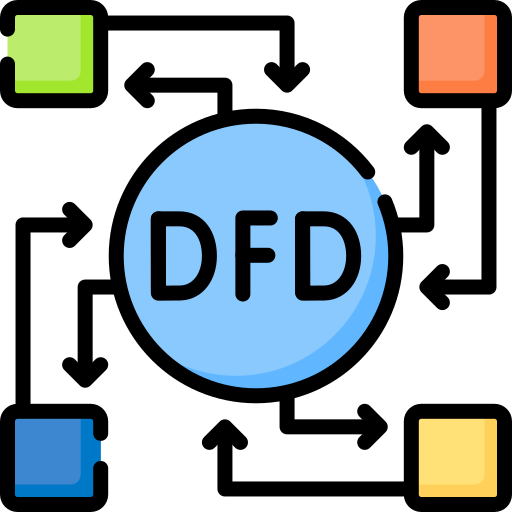
Master systems analysis by creating data flow diagrams to map information through complex systems.

Critically analyse datasets for historical biases that lead to flawed and discriminatory AI algorithms.

Transform boring data into compelling visual stories that convince leaders and drive powerful business decisions.

CASEY
The Creative Technologist
Focus: Expression, aesthetics, experience
Bring your imagination to life by learning digital illustration techniques to paint, draw, and create vibrant characters for your own digital storybook.

Master the magic of photo editing by learning how to use layers and selection tools to combine different images into one impossible creature.

Discover the secrets of animation by creating your own stop motion movie, learning how to sequence still images to create the illusion of movement.
Understand pixels versus vectors, and learn to design scalable digital logos that look perfect on a smartphone screen or a massive city billboard.

Step into the recording studio and learn how to record, edit, and mix digital audio tracks to produce your very own professional podcast.
Expand your creative skills by learning the basics of 3D modelling, turning flat digital shapes into complex, three-dimensional virtual sculptures.

Learn how professional developers plan software by creating UI wireframes, focusing on user experience and layout before writing any actual code.

Combine technical constraints with creativity by designing custom pixel art assets, characters, and environments for your own retro 2D video games.

Master advanced CSS techniques to create responsive web designs that adapt seamlessly to look perfect on mobile phones, tablets, and desktop monitors.

Explore the frontier of digital creativity by learning how to craft precise text prompts to generate stunning visual art using artificial intelligence.

COLBY
The Communicator
Focus: Clarity, professionalism, efficiency🧐 Sorry, I looked and there is nothing to see.

DAKOTA
The Data Custodian
Focus: Integrity, structure, governance
Discover how computers organise information by learning the basics of data categorisation and sorting techniques in this introductory KS3 lesson.
Transform raw survey data into clear digital graphs and discover how visualising information helps us spot trends and patterns.

Learn the fundamentals of binary code to understand how computers use combinations of zeros and ones to represent all digital information.

Understand the difference between flat files and relational databases to prevent messy data storage.

Become a digital detective by learning the basics of SQL commands to search, filter, and extract specific information from databases.
Explore the world of Big Data and analyse the Three Vs - velocity, volume, and variety - to understand modern data processing.

Learn how to protect database integrity by implementing data validation rules that check for errors and stop invalid information.

Discover how hashing algorithms create unique digital fingerprints to securely store passwords and verify the integrity of important files.
Analyse the mechanics of blockchain technology to understand decentralised ledgers, consensus algorithms, and the secure future of digital transactions.
Master database normalisation by learning the strict rules required to process complex data sets into First, Second, and Third Normal Form.

DREW
The Digital Protector
Focus: Integrity, resilience, awareness
Learn the basics of authentication and access control. Discover how computer systems protect secrets and block unauthorised users in this engaging KS3 lesson.
Learn how hackers guess passwords using brute force attacks and master the art of building unbreakable digital defences. Keep your secrets safe!

Don't let scammers reel you in! Learn to spot phishing emails, protect your personal data, and become the ultimate digital detective.
Turn your classroom into a digital fortress! Students learn how firewalls filter packets and block hackers in this hands-on KS3 network security lesson.

Explore the history of cryptography and learn the basics of encryption by cracking the ancient Caesar cipher.

Identify the different types of malicious software, including viruses, worms, and Trojans, and learn how to defend against them.
Discover why passwords are no longer enough and learn how two-factor authentication adds an essential layer of digital security.

Investigate the mechanics of SQL injection attacks to understand database vulnerabilities and learn how developers write secure, patched code.

Step into the role of a digital forensics analyst to learn how cybercrime is investigated and how digital evidence is securely gathered.

Explore the ethical hacking profession and learn how penetration testers identify and exploit system vulnerabilities to improve cybersecurity.
GABE
The Game Developer
Focus: Engagement, interconnectivity, fairness🧐 Sorry, I looked and there is nothing to see.

HARLEY
The Healthy Technologist
Focus: Ergonomics, wellbeing, responsibility
Discover how to build healthy digital habits by finding the perfect balance between screen time, physical activity, and offline play.

Learn the principles of computer ergonomics to design a healthy, comfortable workspace that prevents back pain and repetitive strain injuries.
Explore the causes of digital anxiety and learn practical, effective strategies to manage stress and protect your mental health online.

Identify the physical risks of prolonged device use and learn essential exercises to prevent tech neck, eye strain, and headaches.

Take control of your attention by learning how to manage digital distractions, silence notifications, and improve your daily focus.

Investigate the psychology behind app design and learn how features like the infinite scroll are engineered to keep you hooked.
Understand the biology of sleep and discover how the blue light emitted by digital screens disrupts your natural circadian rhythm.

Analyse how social media algorithms create filter bubbles and echo chambers, limiting our exposure to diverse viewpoints and new ideas.

Explore ethical user interface design and learn how developers can create software that prioritises user wellbeing over aggressive engagement metrics.

Dissect the deceptive world of dark patterns in UI design and learn to distinguish between manipulative interfaces and honest digital experiences.

HARLOW
The Historian
Focus: Continuity, context, legacy
Discover the massive, room-sized computers of the past powered by vacuum tubes, and explore how early computing changed the world forever.

Explore the fascinating history of gaming by looking at

Learn about Ada Lovelace, the brilliant mathematician who envisioned the power of algorithms and became the world's very first computer programmer.

Discover how Alan Turing and his team built the Bombe machine to crack the Enigma code, helping to end the Second World War.
Trace the incredible evolution of computer hardware across five distinct generations, from fragile vacuum tubes to modern artificial intelligence.

Investigate the origins of the internet by exploring ARPANET, the pioneering military network that first introduced packet switching and global digital communication.

Analyse the fierce 'Browser Wars' of the 1990s and 2000s to understand how competition shaped the modern web and internet standards.

Explore Moore's Law to understand the rapid exponential growth of computing power and debate the physical limits of modern microprocessor design.
Dissect Charles Babbage's Analytical Engine, the visionary 19th-century mechanical computer that introduced the theoretical architecture of modern programmable machines.
Trace the fascinating evolution of cryptography, from ancient substitution ciphers to the complex mathematical algorithms securing modern digital communications.
INDIANA
The Implementer
Focus: Execution, modularity, automation
Start your coding journey by building a digital safari. Learn to sequence visual blocks and bring your own animated characters to life.

Discover the power of loops in programming. Learn how to use repetition to write efficient code and save time when building algorithms.
Write your very first text-based program by coding a Python chatbot. Learn about inputs, outputs, and storing data in variables.
Combine maths and programming by using Python Turtle graphics to draw colourful shapes, complex patterns, and digital art with code.

Build a digital Magic 8-Ball game in Python. Learn how to use random numbers and IF statements to make your program make decisions.
Upgrade your programming skills by building a digital quiz. Learn how to store and manage multiple pieces of data using lists and arrays.
Become a debugging detective and learn how to identify, understand, and fix frustrating syntax errors and logic bugs in your Python code.

Learn the foundational languages of the internet. Write HTML to structure your content and CSS to style your very own professional web portfolio.

Connect your code to the real world by integrating external APIs. Fetch live JSON data to build a functional, real-time weather application.


MORGAN
The Modeller
Focus: Abstraction, representation, simplification
Discover how to design your own mobile apps without writing any code by creating paper prototypes to model user interfaces.
Learn the basics of financial modelling and spreadsheet formulas by managing the budget for your very own virtual school tuck shop.

Step into the world of 3D modelling and learn how to design a virtual keyring that could be printed into a real object.


Use digital simulation tools to model computer networks and discover which network topologies are the fastest and most reliable.

Explore how meteorologists use complex computer models and multiple variables to simulate the atmosphere and predict the weather accurately.
Uncover the maths behind your favourite games by learning how physics engines model gravity, collisions, and movement in virtual worlds.

Apply advanced computational modelling to simulate supermarket queues, analysing arrival rates and service times to optimise efficiency and reduce waiting.
Analyse global climate models to understand how scientists simulate the Earth's complex systems and predict the long-term impacts of climate change.
Dive into the future of computing by modelling quantum superposition and learning how quantum bits break the rules of classical physics.

NICKY
The Network Engineer
Focus: Connectivity, bandwidth, resilience🧐 Sorry, I looked and there is nothing to see.
PEYTON
The Problem Solver
Focus: Methodical, logical, evaluative
Learn the importance of precise algorithmic instructions by trying to program a human to make a jam sandwich without causing a complete mess.

Discover how to solve massive problems by using decomposition to break a complex party planning task into small, manageable, and easy-to-solve steps.

Compare linear and binary search algorithms to discover how computer scientists find information quickly and why mathematical efficiency is crucial for performance.
Step into the world of algorithmic sorting. Learn how the bubble sort algorithm works by logically comparing and swapping data into perfect order.
Master the fundamentals of Boolean logic by solving complex puzzles and building truth tables to understand how computers make decisions.
Learn how to map out complex software logic visually using standard flowchart symbols before writing a single line of actual code.
Develop advanced debugging skills by learning how to use trace tables to track variables, play computer, and hunt down hidden logic errors.

Explore the concept of abstraction by analysing the London Tube map, learning how hiding unnecessary complexity helps programmers solve real-world problems efficiently.

Master the elegant but mind-bending concept of recursion, learning how to write subroutines that call themselves to solve complex mathematical and structural problems.

Dive into theoretical computer science by exploring the Travelling Salesman problem and the limits of modern computation with P vs NP complexity.
RILEY
The Responsible Innovator
Focus: Integrity, sustainability, inclusivity
Discover how your online actions create a permanent digital footprint and learn to navigate social media with respect and responsibility.

Learn to identify cyberbullying, understand its impact, and take positive action using the essential

Explore the digital divide to understand why unequal access to the internet and technology affects education and opportunities worldwide.

Understand the Computer Misuse Act and learn the legal boundaries of hacking, data access, and cybersecurity in the UK.

Learn the difference between inspiration and plagiarism while exploring copyright laws to protect creative work and respect original creators.

Investigate algorithmic bias to understand how artificial intelligence can make unfair decisions and learn how developers try to fix it.
Analyse the technology behind deepfakes to understand the dangers of synthetic media and learn how to verify digital evidence.

Debate the ethics of mass surveillance and social credit systems, examining the critical balance between public security and personal privacy.

Evaluate the ethical and legal implications of automation, focusing on accountability when autonomous systems like self-driving cars fail.

Analyse the complex copyright challenges surrounding generative AI, exploring intellectual property rights and the future of human creativity.

ROWAN
The Researcher
Focus: Curiosity, skepticism, integrity🧐 Sorry, I looked and there is nothing to see.
SAM
The System Administrator
Focus: Stability, automation, resilience🧐 Sorry, I looked and there is nothing to see.
SASHA
The System Integrator
Focus: Connectivity, synergy, interoperability
Explore modern software architecture by learning how containerisation and microservices allow for scalable, resilient, and efficiently managed cloud applications.

Explore the physical components of a computer system. Learn to identify input and output devices and understand how they interact with the machine.

Discover how computers connect by mapping out Local Area Networks and Wide Area Networks to understand the global structure of the internet.

Learn how the internet sends data using packet switching, breaking down information into tiny pieces to travel quickly across the globe.

Compare the world's most popular operating systems to understand how Windows, Linux, and macOS manage computer hardware and software.

Understand the vital role of routers in network communication and learn how to trace the path of data across the internet.

Demystify cloud computing by exploring data centres, remote servers, and the infrastructure that powers our online storage and applications.
Discover the power of virtualisation and learn how virtual machines allow developers to run multiple operating systems on a single physical computer.

Uncover how the Domain Name System translates human-readable web addresses into the IP addresses that computers use to communicate.

Analyse network protocols to understand the strict rules and standards that govern how different computer systems communicate and share data globally.
SYDNEY
The Sustainable Technologist
Focus: Efficiency, stewardship, awareness
Discover what happens to broken electronic toys and learn how recycling robots and gadgets helps protect our environment from toxic e-waste.

Uncover the hidden treasures inside old smartphones and learn how extracting gold and metals from e-waste reduces the need for destructive mining.
Compare the environmental impact of printing paper versus sending digital files to find out which option truly has the lowest carbon footprint.

Trace the lifecycle of a smartphone from mining raw materials to manufacturing and disposal to understand the true environmental cost of technology.

Investigate the controversial practice of planned obsolescence and discover how tech companies design products to fail, forcing consumers to buy continuous upgrades.

Learn how to calculate the carbon footprint of your daily internet use, streaming habits, and gaming sessions to become a sustainable technologist.

Explore the principles of the circular economy and learn how designing technology for repair and reuse can eliminate the global e-waste crisis.
Analyse the principles of green coding to understand how optimising algorithms and writing efficient software can drastically reduce global energy consumption.
Evaluate the massive environmental impact of cloud computing data centres and explore the innovative cooling technologies required to make them sustainable.

Investigate the Right to Repair movement, analysing the legal battles between tech giants and consumers over access to spare parts and repair manuals.
TAYLOR
The Technician
Focus: Tangibility, connectivity, utility
Discover how to control robots by writing clear, step-by-step algorithms, bridging the gap between digital code and physical movement.
Take a look inside a computer to identify essential hardware components like the CPU, RAM, and storage, and understand how they work together.

Learn to program a BBC micro:bit using block code to control LED lights and respond to physical movement like shaking.
Explore the Fetch-Decode-Execute cycle to understand exactly how a computer's Central Processing Unit processes instructions and performs calculations.

Develop essential IT support skills by learning how to logically troubleshoot and fix common local area network and printer connection issues.

Master the fundamentals of Boolean logic and learn how to combine AND, OR, and NOT gates to build complex digital circuits.

Discover how sensors and actuators work together in embedded systems to create automated smart home environments that react to physical changes.
Program a robot to navigate a track using a line-following algorithm, applying control structures and sensor feedback in a physical environment.
Bridge the gap between software and hardware by writing low-level assembly language to directly manipulate CPU registers and memory.

Analyse the Von Neumann architecture, exploring the stored-program concept and the fundamental design that underpins almost all modern computer systems.
Last modified: June 18th, 2026